

How to Make Foolproof Flaky Pie Crust
Welcome to my foolproof flaky pie crust recipe, where I’ll guide you through creating a perfect all-butter pie crust that’s easy to prepare and practically impossible to mess up. If you’re looking for the best flaky pie crust recipe that anyone can make, this is it!

This flaky pie crust is my go-to for all of my pie baking and I’ve probably made it hundreds of times over the last 10+ years. I know there are a lot of recipes and opinions out there when it comes to pie, but this is the crust that never fails me.
It’s not just very flaky and tender, but it’s also full of delicious buttery flavor all on its own. Combine this pie crust with your favorite filling and I promise it will be a tasty match made in heaven! And if making pies intimidates you, this tutorial is a great place to start.
“I’ve always had a hard time getting a flaky pie crust, and this recipe is now my go-to. Delicious!!!” — from reader Marisa
“Ever since I found your sheeting technique several years ago, I’ve made all my crusts this way. I’ve used it for sweet/dessert pies, chicken pot pies, hand pies, and my favorite…pie crust cookies. The crust comes out so flaky and tender every time. Thanks so much!” — from reader KDub
Pie crust ingredients

Let’s get started! For the most basic butter pie crust, you need just 4-5 simple ingredients (view the full recipe below):
- All-purpose flour
- Butter
- Granulated sugar (optional, for sweet/dessert pies)
- Coarse salt
- Cold water
Give your pie crust a flavor boost! My favorite way to make this recipe is with buttermilk instead of water. So much flavor and it adds a touch of tenderness to the flaky layers! Click here to see my buttermilk pie crust variation.
baking tip:What causes flaky layers in a pie crust?
How to make homemade pie crust
There are three ways I know of to make pie dough:
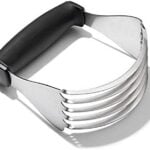
- With a pastry blender, using it to cut the butter into dry ingredients. This is probably the most common method.
- Using a food processor, which works great, especially if you’re short on time.
- By rolling out the butter into the dry ingredients, the method I’m going to show you here.
These are all fine options! But I want to show you how rolling the butter into the dry ingredients is a guaranteed way to get the perfect flaky pie crust. This method takes a little bit more time and effort, but only about 5 additional minutes, and it works!
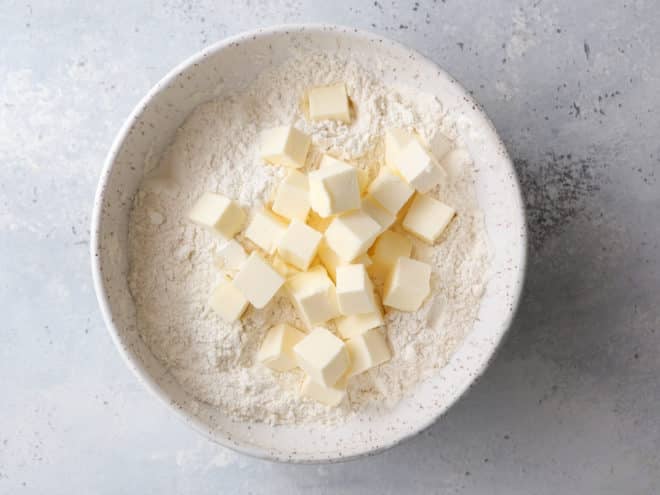
Step 1— Combine dry ingredients and add butter
Combine the flour, salt and sugar (if using) in a bowl and add the cold butter cubes. Toss until all the butter is coated in flour.
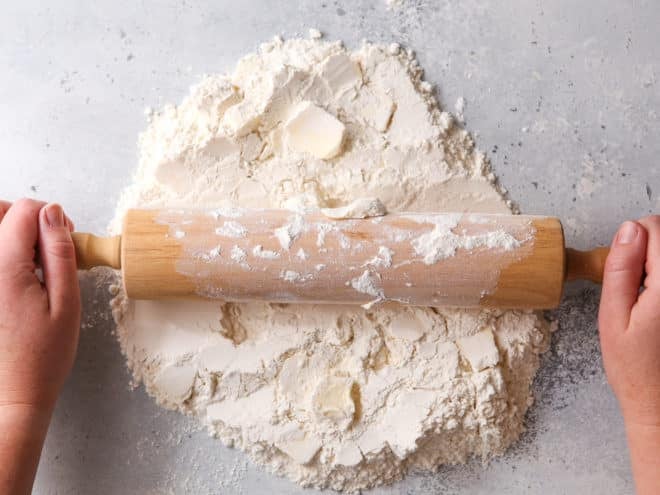
Step 2— Roll butter into dry ingredients
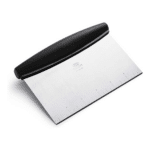
Dump everything out onto a clean surface. Use a rolling pin to flatten the butter cubes and roll them into the dry ingredients. A bench scraper is handy to bring it all back together into a pile, and also to remove butter from the rolling pin as needed.
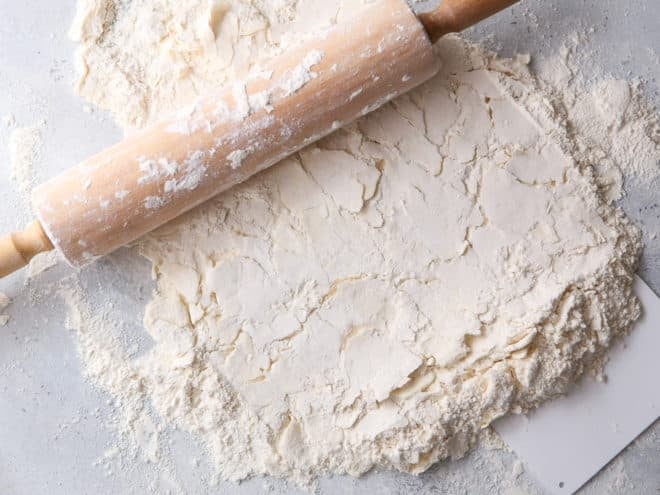
Keep rolling until all of the butter has been rolled into the dry ingredients (yes, this get’s quite messy!). The goal is to have thin sheets of butter visible throughout the dry ingredients. Break up any really long sheets of butter with your bench scraper.
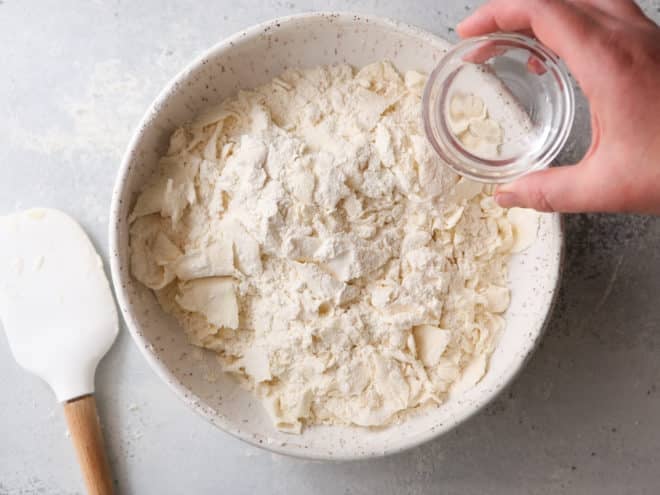
Step 3— Add ice water
Gather up the mixture and return it to the bowl. Place the bowl in the freezer for a few minutes if needed, just to get everything cold again. Then, make a well in the center and add about 2-3 tablespoons of cold water (or buttermilk if using that variation).
Use a large spoon and then your hands to bring the mixture together into a ball. If necessary, add more cold water 1 tablespoon at a time. I always need to add more water, anywhere from ¼ cup – ½ cup total, but it’s different every time and so I start with a small amount and slowly add more. Adding too much water will make the dough sticky and produce a tough crust.
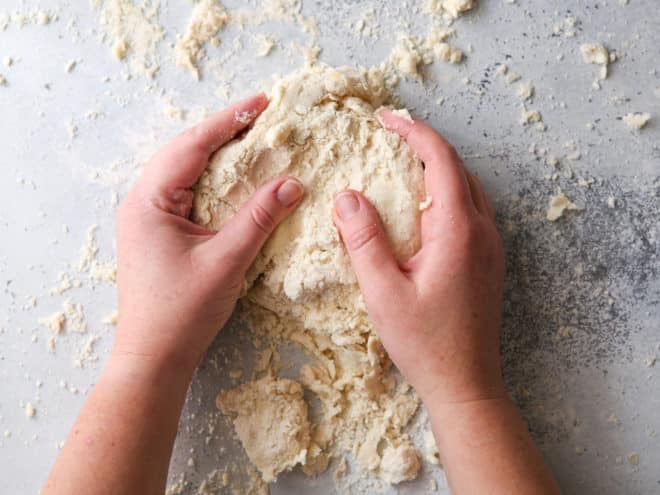
Step 4— Form dough into disks
The dough should hold together in a ball, but a few loose crumbs are okay. I like to dump the mixture out onto a work surface to bring the dough together with my hands. You don’t want to over-work it, but a little kneading and handling is just fine.
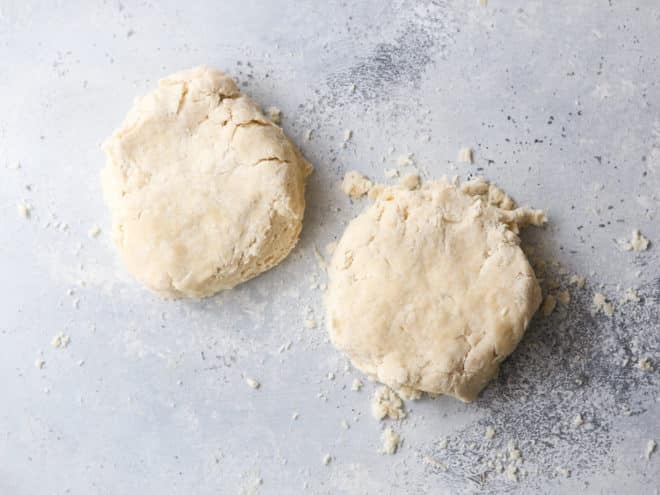
Divide the dough in half and flatten each into a disk. Cover with plastic wrap and chill in the fridge for at least 2 hours. Then, you’re ready to bake a pie!
How to roll out pie crust
- Let dough rest at room temperature for 5-10 minutes on a lightly floured surface.
- Use a rolling to begin rolling out the disk. This may be hard at first while it’s thick and cold, but move from the center outwards and it should take shape.
- Every few rolls, rotate the dough a quarter turn on your surface and add more flour if needed.
- Keep rolling until it’s the size you want and evenly thin. Encourage the dough into a circle, and reshape with your hands if needed or if the dough cracks.
- Roll the pie crust up onto your rolling pin and transfer it to a pie plate, then use it according to your pie recipe’s instructions.

Pie crust tips for success!
- The bigger the butter chunks, the flakier your pie will be. So don’t be afraid to leave larger pieces throughout.
- Keep ingredients and dough cold. In order to get those flaky layers, the butter needs to stay separate from the flour. Start with cold butter and water, chill the dough mixture as needed while you’re working with it, and rest the dough in the fridge before rolling it out.
- Cut this recipe in half for a single-crust pie. Or you can freeze the second disk of dough for another time.
- Use an egg wash. In order to get a shiny golden crust once baked, brush the dough with a simple whisked mixture of 1 egg + 1 tablespoon of water.
- Pie crust storage: Pie crust dough will keep in the fridge up to 5 days and in the freezer (double-wrapped) for up to 2 months. Thaw overnight in the fridge.
- Make pie crust ahead of time: It’s easy to do and a great time saver! For example, I usually make pie crusts for Thanksgiving 1-2 weeks before so it’s one less thing to worry about in the busy days before the holiday.
My favorite pies to make with this pie crust
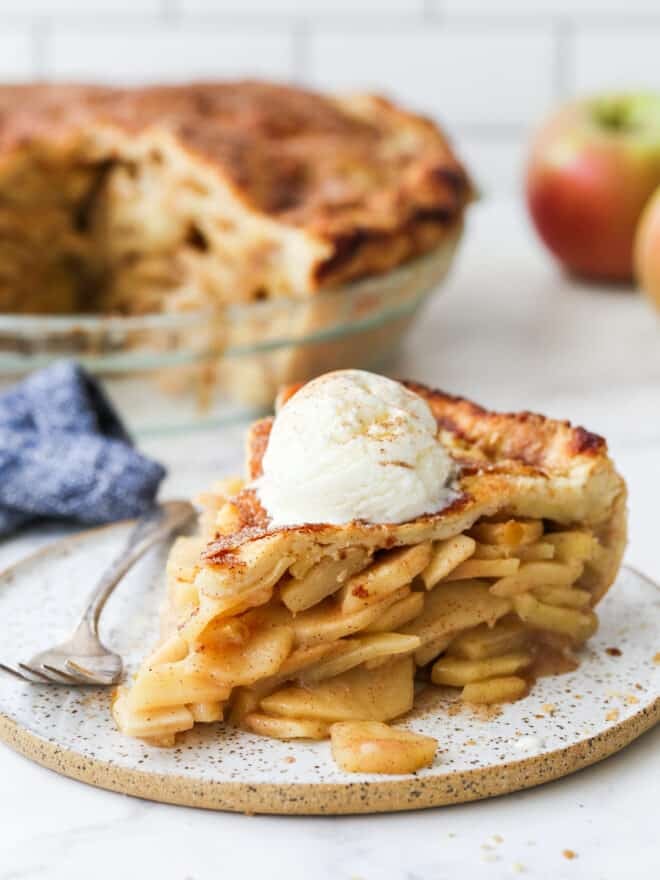

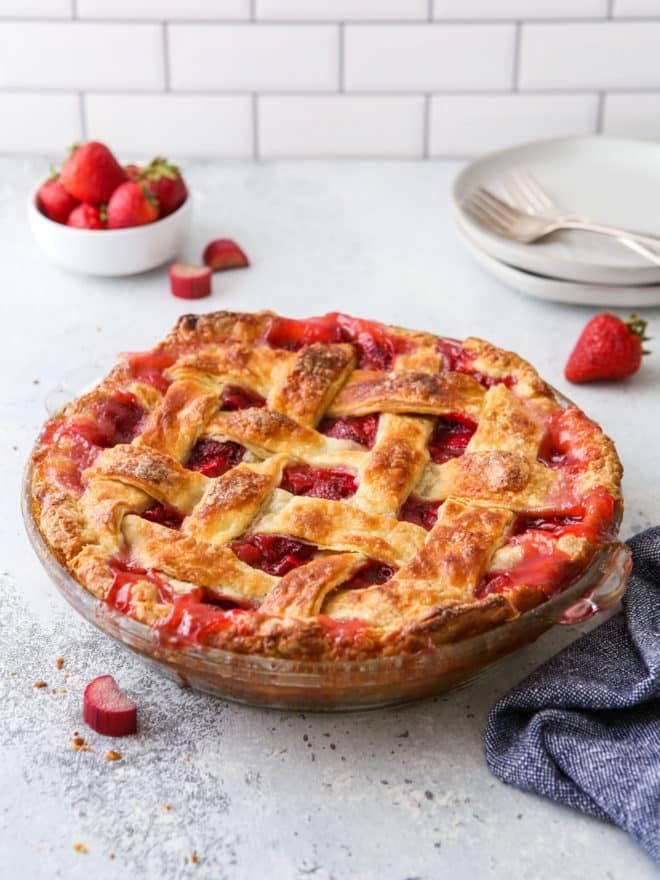
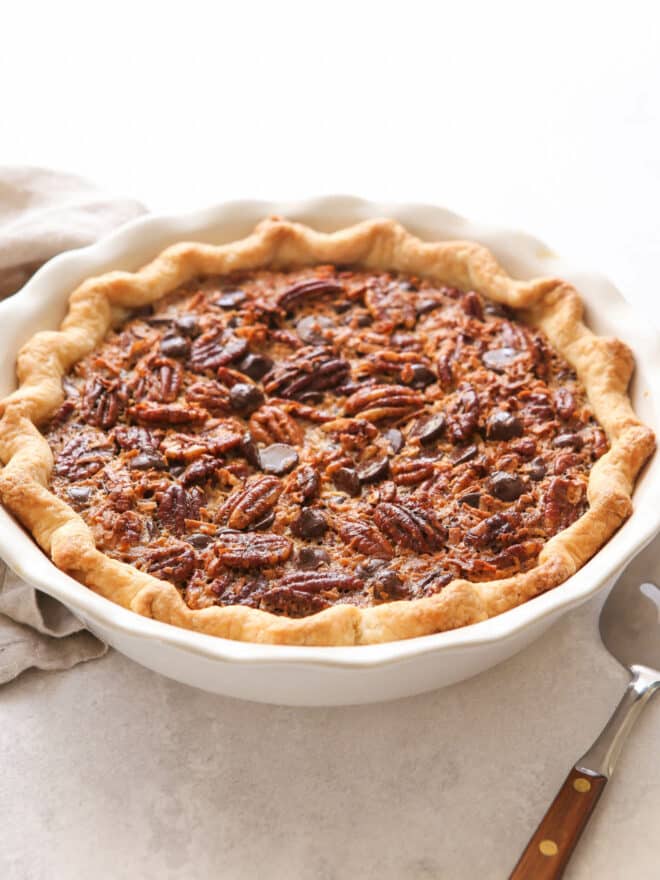
Get the best pie crust recipe
The Best Flaky Pie Crust
Ingredients
- 2 ½ cups (300 grams) all-purpose flour
- 1 tablespoon granulated sugar , optional
- 1 teaspoon salt
- 1 cup (226 grams) unsalted butter , cold and cut into cubes
- ¼-½ cup (56-113 grams) ice cold water , as needed (see Notes)

Instructions
- Combine the flour, sugar (if using), and salt in a bowl. Add the cubed butter and toss to coat.
- Dump the mixture out onto a clean surface and use a rolling pin to roll the butter into thin sheets, combining it with the flour. Use a bench scraper to scrape the rolling pin and to bring the mixture back into a pile as necessary. Continue until all of the butter is incorporated into the flour. Mixture will be very flaky.
- Return mixture to the bowl and place in the freezer for 10 minutes to chill the butter.
- Remove from freezer and add ¼ cup of the ice cold water. Use a spoon and then your hands to stir the mixture until it comes together into a ball. If mixture is too dry, add additional water a tablespoon at a time. I usually end up needing slightly more than ¼ cup but it varies each time. It's okay if some dry bits remain, but you should be able to shape the dough together.
- Divide the dough in half and flatten into 2 disks. Wrap each disk in plastic wrap and chill in the fridge for at least 1 hour (2+ hours preferred) and up to 5 days.
- To freeze pie crust, wrap in double layers of plastic wrap and store in the freezer for up to 2 months. Let thaw overnight in the fridge before using.
Video
Notes
- Makes enough dough for one double crust 9-inch pie. Recipe can be cut in half for a single crust pie.
- You can find my buttermilk pie crust variation here. It’s my favorite for fruit pies! If you use buttermilk instead of water, know that you will need closer to ½ cup.
- If you’re looking to speed things up, check out my tutorial on how to make pie crust in a food processor here.

The information shared is very good, thanks to the author, it helps me a lot, I am looking for it.
You have creative hands and minds of great food, really the recipes you share I feel very delicious and beautiful, thank you for sharing these great recipes.
Tonight I mixed up a crust using the method of mixing the flour and butter directly on the table with a rolling pin. The dough is now resting in the refrigerator until tomorrow night.
I’ve tried numerous other methods with varying amounts of success. I know I over mix the fat and use too much water. Methods that work for others don’t necessarily work for all. I took a pie making class with a well known instructor. I’ve not been able to duplicate my success from the pie I made in that class. She told me I over mix the fat and flour. Maybe using this method will help me.
My method is out there, and I’m hoping this is it.
I hope this is it too!! Please come back and tell me how it worked out!
The pie crust was a complete success. Tender and flaky. I will from this day forward mix the fat into the flour on the table with the rolling pin. Wow. Who knew.
Thank you for the instructions.
YAY!! Oh I’m so glad you had success with this method and recipe. I hope there is lots of pie baking in your future! Thanks for feedback. 🙂
The way you prepare it is great, very easy to understand and apply, I have succeeded with so many things you teach. Thank you for making me a good chef
I work at a US Park Service Historic Site and bake in a early 1800’s wood fired brick oven. All of he bread and pies and pastries. I tried this method some years back and consider it a God Send. The one part of making pastry dough that is always a BOOGER is cutting in the butter. This method solved all of my problems and worked the first time and a bazillion times afterward. Thank you so much for this method. I also teach it to kids that work in the kitchen and they pick it up right away and make perfect pies. (Crostatas, and Galettes) And I am a ……………. “guy”.
Hi Dennis! I love this, thank you so much for sharing! I would love to see and bake in that oven, that sounds so fascinating. I’m happy to hear this recipe was such a success! 🙂
You are a genius!!! Just did a trial run through this recipe before trying it out on some Thanksgiving pies! I have never been able to master homemade pie crust.. until now ? I told my kids- we’re eating real pie this year guys! Haha. Not sure where the not-so-happy commenters went wrong but I think it’s fool proof! Thank you!
Also, you recommended non-salted butter but all I had was salted butter… so I only put 1/2 tsp of salt. It seemed to do the trick.
Again- thank you so much! Happy Thanksgiving ?
Annalise have you ever use vegetable shortening in your pie crust.
thx
Paula
I’m not sure I ever have! If so it’s been years. I find that when handled properly, an all-butter pie crust yields so much flakiness, and without compromising any flavor!
I’m totally in love with this recipe.
I had a really hard time getting the dough to come together and I genuinely thought I over mixed the dough and made it tough. When I baked it though it turned out really nice! I’m so glad I know how to make my own pie dough now 🙂 it was delicious with my buttermilk veggie quiche.
I’m so glad it worked out! Mixing in the liquid is always my least favorite part, and I always stress about whether I’ve added too little or too much of it. So you’re not alone! Happy pie baking! 🙂
I must be pleased for sharing your ideas. Thank you for the good writes up. It’s a brilliant job.
Hi Annelise
Can’t wait to try this recipe! Can see by the comments it Will be a winner!! Trying desperately to ‘find’ your recipe for the bundt carrot cake with cream cheese swirl and your choc cake which has been mentioned in the above comments, for some reason I can’t open it even tried the Betty Crocker site?? Please help.
Thanks Kathy
Hi Kathy! You can find the cheesecake-swirled carrot bundt cake recipe here. I’m not sure what chocolate cake recipe you’re looking for? You can find all my cake recipes in my recipe archives.
I tried the crust recipe, must have done something wrong, it didn’t come out right this so hard and weird looking. Will try again tomorrow.
I made a pie dough in my food processor and it came out beautiful. I let it cool in the fridge. I could not roll it out, it just cracked and fell apart, I had to piece the dough in the pan. What was wrong.
Hi Patricia! I’m sorry to hear you had trouble with this recipe, and I know how frustrating it is when a pie crust doesn’t turn out. I can’t say for sure what went wrong, but I’m wondering if there wasn’t quite enough liquid to bind the crust together? Also, my crusts are always rock hard when I take them out of the fridge so I let them sit on the counter for about 10 minutes, which seems to make it more pliable and less likely to crack. Something to try next time!
What oven temp do you recommend for apple pies with this crust?
I usually bake my pies at 400 degrees F.
I have tried other pie crust recipes that were disasters. Your recipe and tips were the bomb and thanks to your detailed instructions and tips I finally was able to make the perfect pie crust Thank you!