

How to Bake Flat Cake Layers
No more trimming and leveling, and no special tools needed! Come learn how to easily bake flat, even cake layers every time.
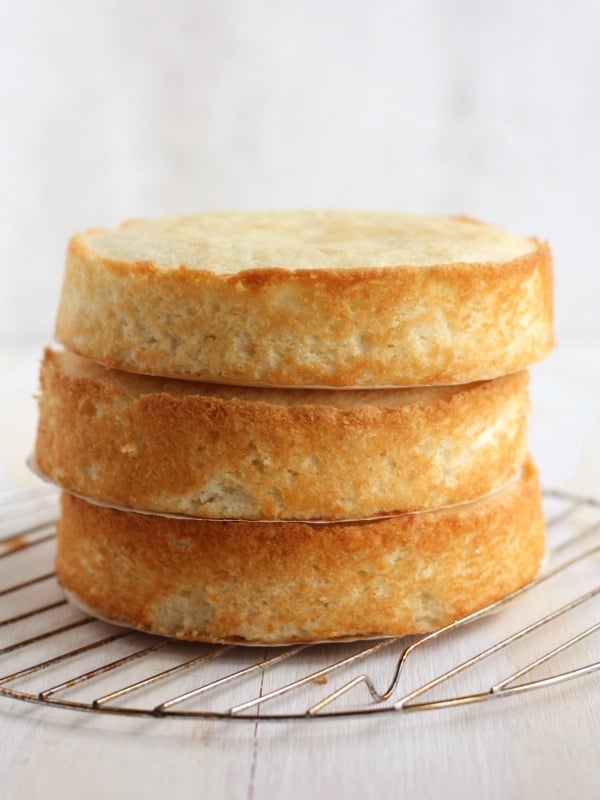
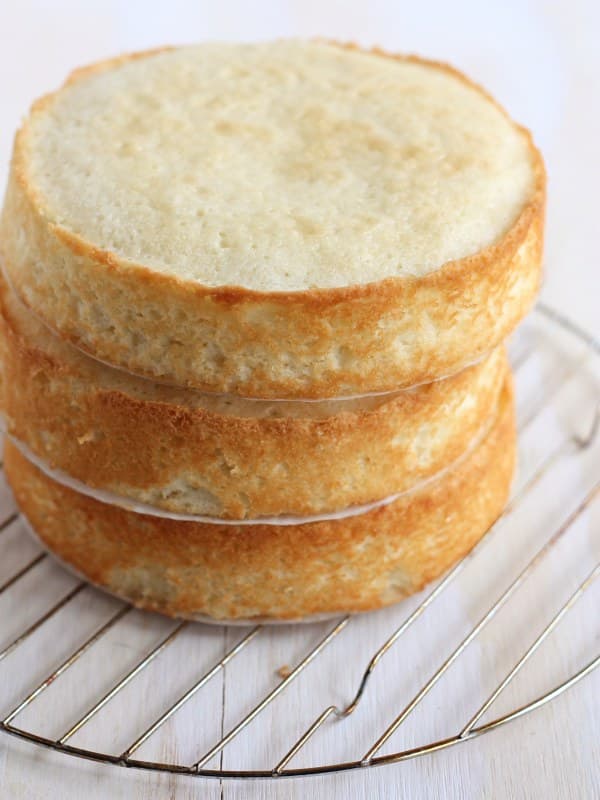
Leveling cakes is super frustrating, right? First off, it’s hard to get it perfectly even without a specific cake leveler tool, and secondly, you waste cake. I like snacking on trimmings as much as the next gal, but I like fuller, taller cakes more. So come learn my little secret trick to getting flat cake layers right out of the pan!
No special equipment needed!
A lot of baking advice says to use cake strips to achieve flat cakes with no domes, but I’ve actually never used them. If you like them, then go ahead and use them! I hear they can work quite well
But, let me show you how you can get the same results without needing to use a separate tool. (Does anyone else despise single-use kitchen gadgets?)
How to bake flat, even cake layers
Here they are in just 3 simple steps, we’ll dive more into each in just a moment.
- Divide cake batter evenly between your cake pans.
- Reduce the baking temperature.
- Bake in the middle rack only.
Divide batter evenly between cake pans
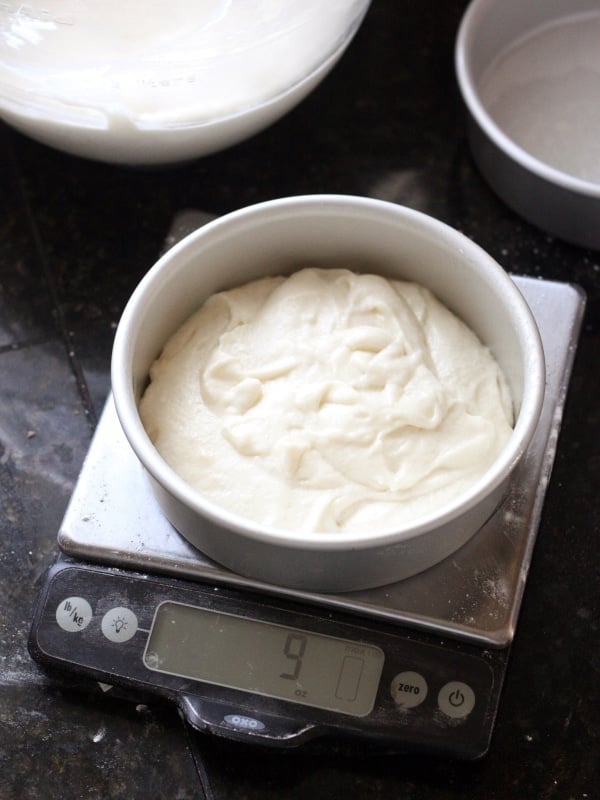
Flat, even cake layers begin with equal amounts of batter in each cake pan. The best way to do that is with a digital scale. Simply place the cake pans on the scale one at a time and pour equal amounts into each.
If you don’t have a kitchen scale, you can also find the total volume of the batter and divide it equally between the pans. However, this method can be less accurate (and dirties more dishes).
Reduce the baking temperature
Baking at a lower temperature slows the spring in the leavening, which prevents a dome from forming on your cake. Most cakes bake at 350°F. Reducing the temperature to 325°F is all you need to do to get a flat-topped cake.
Since you’ve lowered the oven temperature, your cake will now take a little longer to bake. Reducing oven temp by 25 degrees will require you to increase baking time by approximately 1/2. Here’s an example: Bake at 350°F for 30 min → Bake at 325°F for 30 min + 15 min = 45 minutes total.
I usually take a quick peek once I’ve reached the original baking time and then every 5 minutes after that just to be sure I don’t over bake it, but the adjustment above is usually pretty accurate.
Once the center of the cake(s) is set and don’t jiggle when pans are lightly shaken, test for doneness by gently tapping the center. If it bounces back, it’s done. You can also insert a toothpick into the center, and if it comes out with just a few moist crumbs, your cake is done. Note: Always remember that cakes are delicate, so minimize how often you open the oven door.
Bake in the middle rack only
For best results, cakes should always be baked in a single layer on an oven rack placed in the middle of the oven. Trying to bake cakes on multiple racks at the same time usually results in lopsided cakes, and cakes that have browned too much either on the tops or the bottoms.
If I’m baking more than 2 cake layers, I will bake the first 2 together on the same rack in the middle of the oven, and then any subsequent layers after those are out of the oven.
FAQs
A kitchen scale makes things easy, but it’s not necessary. Simply measure the total volume of your batter and divide it by the number of cake pans you’re using/cake layers you’re baking.
Reducing the temperature to 325°F really slows down the baking process. The patience is worth it in the end! And once you’ve baked cakes this way a few times, it becomes much more natural, and you’ll be able to tell easily when the cakes are done.
Leave the oven door closed and check through the window to see that the cake appears set and is not longer moist on top. Then, quickly and carefully open the oven door and press gently with your finger. If it bounces back, then your cake is done! However, if you try to test a cake too soon, pressing the tops may cause it to collapse. If the cake appears to not actually be set once you open the oven door, quickly close it again and try again in a few minutes.
Yes, you can still bake cakes at 350°F or per your recipe’s instructions. The cakes will be evenly thick, but may have a domed top. Once cool, use a serrated knife to carefully cut the dome off.
A few favorite cake recipes
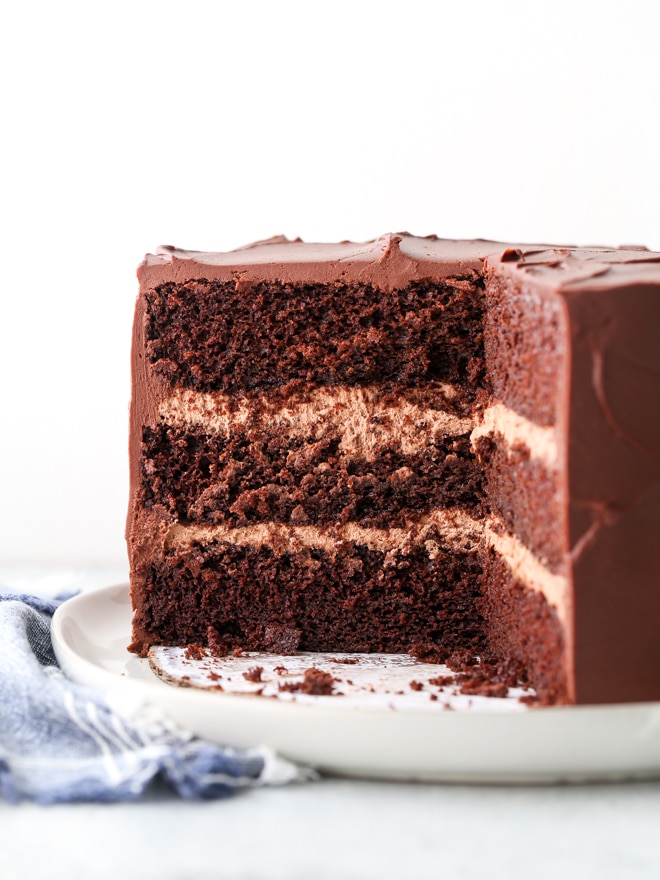
Now that you know how to bake flat cake layers, making a layer cake is easy! Here are a few of my favorites:

Annalise, let me know if you try this. I just wanted to add not to push too hard on the cake but still kind of firm. You can actually watch the top and tell when you have reached the point of evenness.
OK so I have read all of your comments and I can only say that many many years ago when I was doing all that baking (still do some but no where near what I used to) I used a very simple method for smoothing out the cake domes. The minute your cake is removed from the oven, either use an oven mitt or just a pot holder and lay on the top of your cake. Press down to remove the air and the dome goes away on its own. Hope this helps!
I think I have actually heard of that tip before, but haven’t tried it myself. Thanks for reminding me to see how it works next time I bake a cake!
That’s great! I didn’t know that convertion, very useful. Thks for sharing yr knowledge.
To convert from Fahrenheit to Celcius, subract 32, divide by 9 and multiply by 5.
350 F would be (350-32) /9 x 5
318 /9 x 5
35.33 x 5 = 176.66 C (about 177C)
If ever in doubt if you’re doing it right, remember that 98.6F = 37C
Just google, “Fahrenheit to Celsius Calculator”, and Google has their own calculator at the top of the page.
You can make your own baking strips for the pan out of paper kitchen roll and aluminium foil – just a bit of measuring, cutting and folding – takes minutes
Thanks for the tip!
Will this work for cupcakes too??
So this would also work on cakes that you bake that you need to bake longer? I have that delicious choc cake of inspired by chocolate Michelle and find that when I bake it at recommended heat that the smaller cakes are fine but when I bake cakes in bigger diameter they always seem to get real toasty on the outside edge and on top, with center sometimes being almost underbaked?
Sounds like maybe your oven temp is off? Try inserting an oven thermometer before preheating and seeing if it reads the same. If the oven is too hot that could be why the edges burn before the center cooks completely. Good luck!
I always encounter same problem with sponge cake. Normally we are nt allow to insert toothpick in the center for sponge cake. My sponge cake remains unbaked in the centre, even thought it cracks on the top. Oven temperature sounds good. So what else could help me please?
Hi, this is an interesting article, and I agree with equal amounts of batter in pans and lowering the temperature, I do that for less browning on sides and sure the dome is smaller. But, it depens on the recipe. The dome comes from the levening agent too, like baking soda or baking powder. So, some recipes will still have a dome, even after your instructions, while others can have no dome. You didnt specidy what recipe you used. The recipe I use for lemon cake, red velvet does not make a dome, while the pound cake, even with your instructions still has a dome.
Happy baking!
Thank you for your input! I have actually never had a recipe baked with these instructions either have no doming or considerably less doming. I follow these instructions with all of my layer cake recipes.
POUND CAKE IS USUALLY BAKED IN A LOAF PAN WHICH WORSENS THE DOME EFFECT, A CAKE PAN WILL REDUCE THE DOMING EFFECT.
I always bake my cakes at a lower temp. than recipes specify but I also rap the bottom of the pans on the counter to deflate bubbles; while I always get level cakes, there is minimal rise. The cakes are still fluffy but I heard that rapping the pans deflates the batter. Is this what is causing the cakes not to rise?
How do you get your measurements for the amount of batter to use for the size of cake tin?
I rely on the recipe to tell me what size pan and how many to use. Also, as a general rule, I do not fill my cake pans more than 2/3 full.
Sometimes, my pans laugh instead of giggle.
They are very tickelish.
I miss the beach!!!
;o). <3
good lord, woman! I like the way you bake. thanks for the tips.
Such great info! Thanks so much for sharing these useful tips 😉
In Celsius, 350° Fahrenheit =176° Celsius & 50° Fahrenheit = 10° Celsius
So, bake at 165° Celsius.