

How to Bake Flat Cake Layers
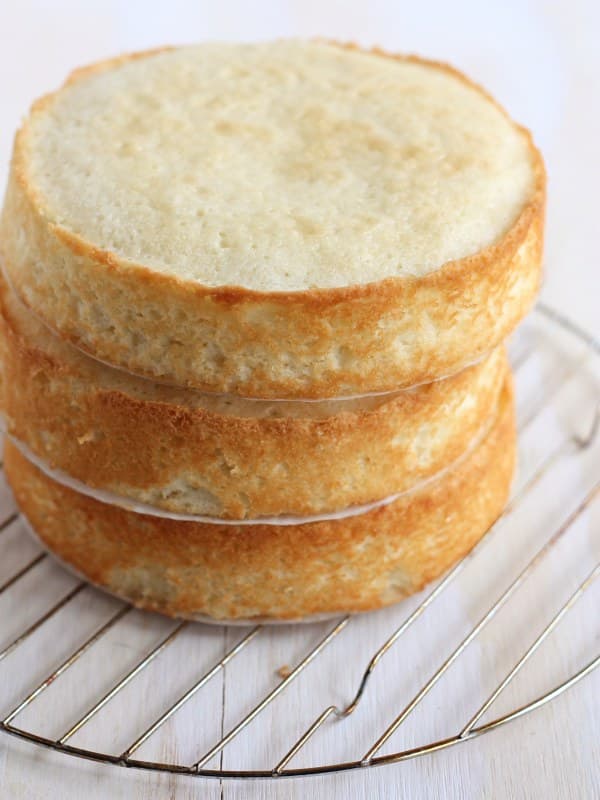
No more trimming and leveling, and no special tools needed! Come learn how to easily bake flat, even cake layers every time.
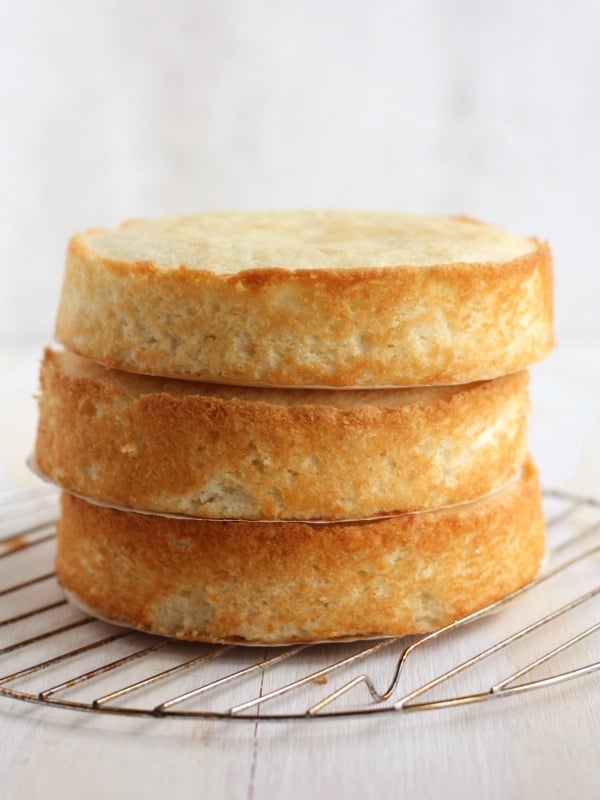
Leveling cakes is super frustrating, right? First off, it’s hard to get it perfectly even without a specific cake leveler tool, and secondly, you waste cake. I like snacking on trimmings as much as the next gal, but I like fuller, taller cakes more. So come learn my little secret trick to getting flat cake layers right out of the pan!
No special equipment needed!
A lot of baking advice says to use cake strips to achieve flat cakes with no domes, but I’ve actually never used them. If you like them, then go ahead and use them! I hear they can work quite well
But, let me show you how you can get the same results without needing to use a separate tool. (Does anyone else despise single-use kitchen gadgets?)
How to bake flat, even cake layers
Here they are in just 3 simple steps, we’ll dive more into each in just a moment.
- Divide cake batter evenly between your cake pans.
- Reduce the baking temperature.
- Bake in the middle rack only.
Divide batter evenly between cake pans
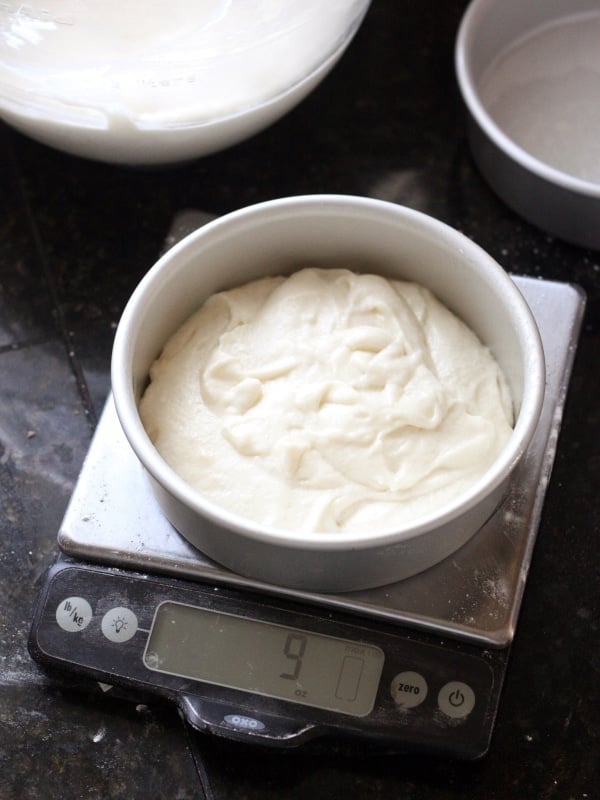
Flat, even cake layers begin with equal amounts of batter in each cake pan. The best way to do that is with a digital scale. Simply place the cake pans on the scale one at a time and pour equal amounts into each.
If you don’t have a kitchen scale, you can also find the total volume of the batter and divide it equally between the pans. However, this method can be less accurate (and dirties more dishes).
Reduce the baking temperature
Baking at a lower temperature slows the spring in the leavening, which prevents a dome from forming on your cake. Most cakes bake at 350°F. Reducing the temperature to 325°F is all you need to do to get a flat-topped cake.
Since you’ve lowered the oven temperature, your cake will now take a little longer to bake. Reducing oven temp by 25 degrees will require you to increase baking time by approximately 1/2. Here’s an example: Bake at 350°F for 30 min → Bake at 325°F for 30 min + 15 min = 45 minutes total.
I usually take a quick peek once I’ve reached the original baking time and then every 5 minutes after that just to be sure I don’t over bake it, but the adjustment above is usually pretty accurate.
Once the center of the cake(s) is set and don’t jiggle when pans are lightly shaken, test for doneness by gently tapping the center. If it bounces back, it’s done. You can also insert a toothpick into the center, and if it comes out with just a few moist crumbs, your cake is done. Note: Always remember that cakes are delicate, so minimize how often you open the oven door.
Bake in the middle rack only
For best results, cakes should always be baked in a single layer on an oven rack placed in the middle of the oven. Trying to bake cakes on multiple racks at the same time usually results in lopsided cakes, and cakes that have browned too much either on the tops or the bottoms.
If I’m baking more than 2 cake layers, I will bake the first 2 together on the same rack in the middle of the oven, and then any subsequent layers after those are out of the oven.
FAQs
A kitchen scale makes things easy, but it’s not necessary. Simply measure the total volume of your batter and divide it by the number of cake pans you’re using/cake layers you’re baking.
Reducing the temperature to 325°F really slows down the baking process. The patience is worth it in the end! And once you’ve baked cakes this way a few times, it becomes much more natural, and you’ll be able to tell easily when the cakes are done.
Leave the oven door closed and check through the window to see that the cake appears set and is not longer moist on top. Then, quickly and carefully open the oven door and press gently with your finger. If it bounces back, then your cake is done! However, if you try to test a cake too soon, pressing the tops may cause it to collapse. If the cake appears to not actually be set once you open the oven door, quickly close it again and try again in a few minutes.
Yes, you can still bake cakes at 350°F or per your recipe’s instructions. The cakes will be evenly thick, but may have a domed top. Once cool, use a serrated knife to carefully cut the dome off.
A few favorite cake recipes
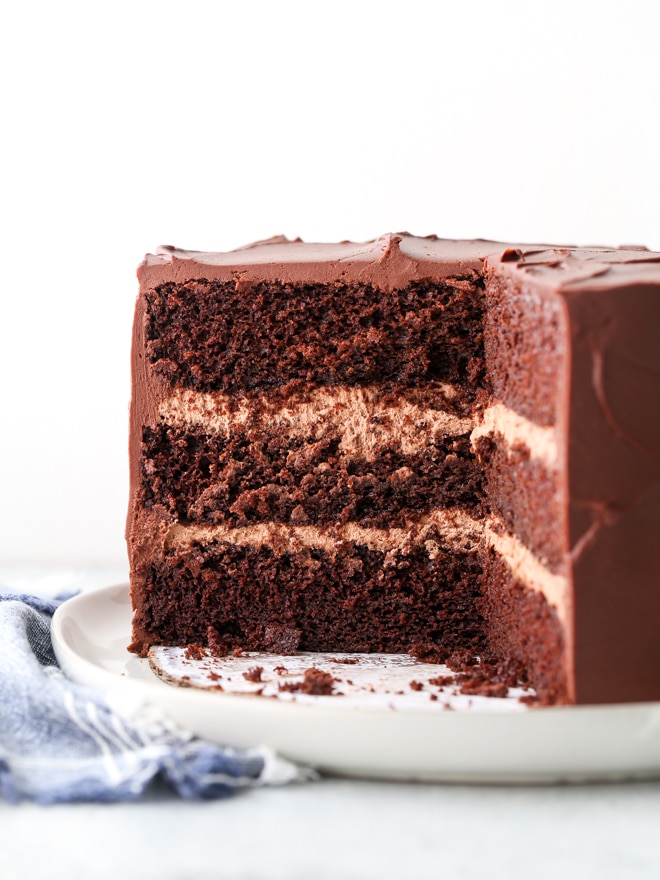
Now that you know how to bake flat cake layers, making a layer cake is easy! Here are a few of my favorites:

love this! so helpful, Im definitely going to try your tips next time! (Now if only I could get my layers to rise that high and thick!!)
Wjen applying the batter into the bowl just make sure your filling up the pan to either half or 3/4 of the pan.
https://www.recipetips.com/kitchen-tips/t–917/temperature-conversion.asp
Thanks for the tips! Here is the actual math conversion but there are so many sites that will just do the math for you.
°C to °F Multiply by 9, then divide by 5, then add 32
°F to °C Deduct 32, then multiply by 5, then divide by 9
or
Celsius to Fahrenheit (°C × 9/5) + 32 = °F
Fahrenheit to Celsius (°F – 32) x 5/9 = °C
Thanks for the info!
lol you can just save yourself the trouble of doing the math by placing the cake pan on the scale, zeroing the scale, and THEN adding your cake batter…..
That’s exactly what I do! But it doesn’t really work for finding the total weight of the batter before pouring it in the pans. You’ll need to know the weight of your bowl so you can subtract it.
Wow! After 40+ years of baking, such a simple fix!
Regarding weighing the batter, you don’t need to subtract, just put equal weights in each pan. Sometimes you need to fuss a tablespoon or so back and forth 😉 Regarding the bake even strips….yes they work but are a major PAIN to use. This method sounds so very simple! Thanks!
why do you need to know the batter weight before going into pan?
I like to know how much batter I’m going to put in each pan, so I get the weight of the batter and then do the math. Then I put the pans on the scale one at a time, zero it out and add that much batter. If you’re better at guessing than I am you can skip it. I just don’t like to go back and forth an ounce or two getting them even, if that makes sense.
Again, simply place the empty bowl on your scale, zero out, then after the batter is finished you reweigh and divide by 3. Then place the cake pan on scale, zero out again, and add that 1/3 amount of batter.
Yeah, that’s what I was going to say!
About the zeroing out the scale! 🙂
I use Wilton’s Bake-Even Strips around my cake pans. My cake layers come out level every time.
I’ve heard that! But never wanted to go to the trouble of buying them. My kitchen is too small!
I had the Wilton strips and they did not work at all for me…
Use pieces of wet, wrung out towel round the outside- it will work just as well if not better (and cheaper)
Thanks for the great tip, Kelli!
Here is a link for conversion chart posted by Simply Delicious:
https://simply-delicious-food.com/2014/03/26/conversion-chart/
I’ve always heard of lowering the temperature but never tried it because I was afraid it would have an affect on texture – but you’ve convinced me! Great post!
I have never noticed a change in texture. Thanks!
Thanks for the tip! That’s always so frustrating when this dome appears! Concerning a measuring converter, I have the App “Units” on my IPhone as I read a lot of American blogs, but we use kilos, meters, Celsius in Switzerland 😉 !
You just saved me soooo much time!! Love this post!
Happy I could help! 🙂
My goodness, you are a genius. Seriously, can’t wait to try this.
Thank you so much! I can’t remember where I learned it from, but it is definitely too good of a tip to keep to myself!
Oh, nice! I did not know this! Would this work for a 9×13 cake? I would assume so… Pinned.
Yes, it should still work, though I’ve never actually tried it myself. It’s been a surprisingly long time since I’ve baked a 9×13 inch cake. But the principal is still the same. If you have any feedback after giving it a try, I’d love it if you came back and shared!
Absolutely! Thank you for a quick response.
Great!!
The conversion is this one:
350ºF = 175ºC …so….. 325ºf=160-165ºC (aprox)
Thank you so much Laura!
Lowering the temperature, huh? Never thought about it. Will try this next time I bake a cake.
Annalise,
This is great info. Can’t wait to try it out. Pinned.
Annamaria
This is so, so, soooo helpful….thank you!! Layer cake secretly kind of scare me for this exact reason (and a few others). Mastering layer cakes, or at least making one decent one is on my culinary bucket list for the year, and this has really given me the little kick I needed to get going with it 🙂
Happy I could help out Kelli! Layer cakes are so fun! You’ll be a master in no time, I’m sure. 🙂
Looks to me like it would be a lot easier just cutting a little bit of the top off. You lost me at measuring the amount in each pan.
I would have thought so too until I actually bought a kitchen scale. Now I LIVE being able to measure everything so accurately.
I’ve done this and the sides of the cake have come out perfectly soft on texture but the top is still slightly too crunchy that when eating you can feel the crunchier texture.
Is there a way to ensure the top of the cake comes out soft like the sides and in your picture?