

Why Sugar is Important in Baking
The more you know about the science of baking, the better baker you’ll be, and the more delicious treats you can enjoy! Today we’re talking about the various reasons why sugar is an important ingredients in baked goods.
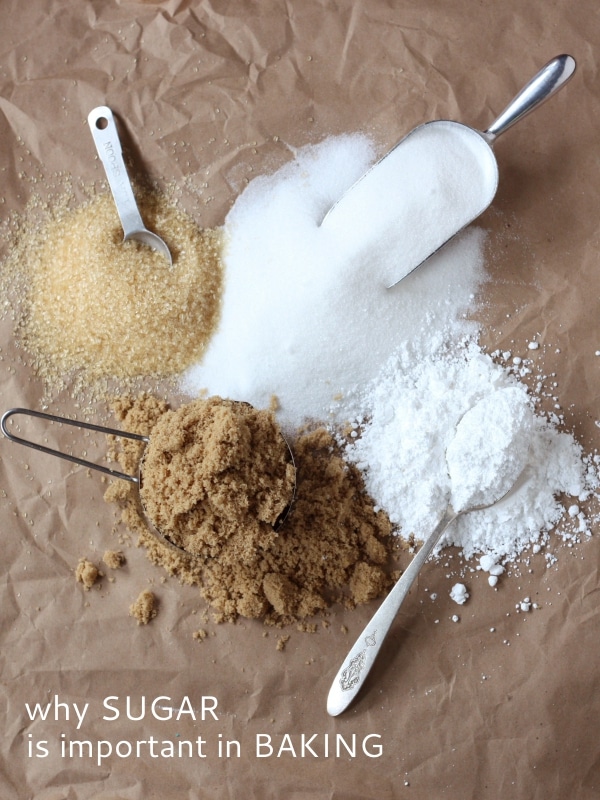
Table of Contents
- Sugar, not just a sweetener
- Different types of sugar
- Liquid sweeteners
- Sugar alternatives and substitutes
- How to store sugar
- How to measure sugar
Sugar, not just a sweetener
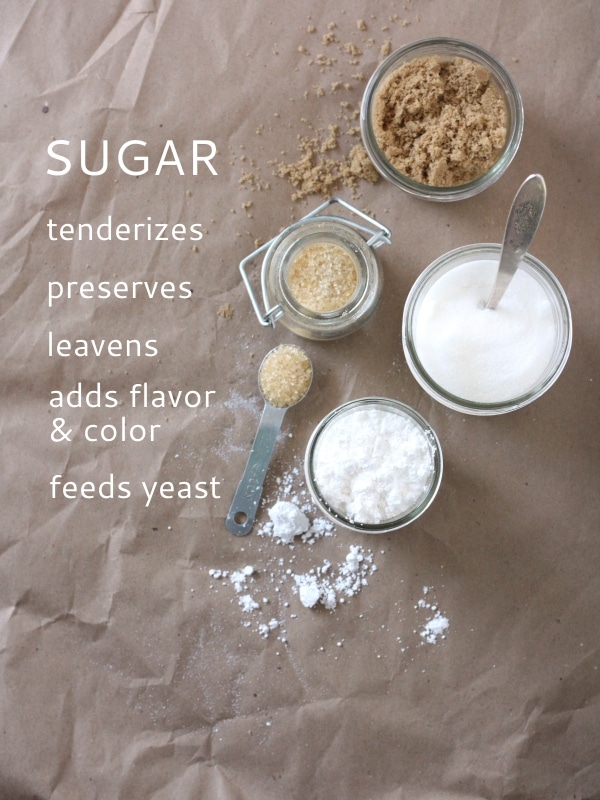
Sugar’s role is not just to provide sweetness, though that is definitely what it is most known for. It actually does a lot of important things in your baked goods:
- Sugar tenderizes by weakening the gluten strands.
- Sugar acts as a preservative by binding up the moisture so that it’s not readily available to react with microbes.
- Sugar works as a leavener through the creaming method and foaming (think meringues).
- Sugar provides flavor and color through caramelization.
- Sugar feeds yeast and enables it to grow.
I think it’s important to understand these basic properties of sugar. In an era where most people consume far too much sugar, and many are trying to cut back, eliminating it completely from your baking isn’t an easy task. Sugar plays an important role and most baked goods wouldn’t be the same without it!
Different types of sugar
Sugar exists in two ways, either naturally in things like fruit and milk, or through the process of refining it from sugar cane and sugar beets.
Turbinado Sugar— is the closest to raw sugar available. It is only partially refined, light brown in color, with coarse crystals and a caramel flavor.
Granulated Sugar— is the standard sugar used in the kitchen. The crystals are white, fine and uniform in size.
Superfine Sugar (Caster Sugar)— is granulated sugar with smaller-sized crystals. You can make your own by pulsing granulated sugar in a food processor a few times.
Powdered Sugar (Confectioner’s Sugar)— is made by grinding granulated sugar through different degrees of fine screens. Because of its tendency to lump, cornstarch is added to absorb moisture.
Brown Sugar— is granulated sugar with molasses added back in. The amount added back in determines whether it’s light brown sugar or dark brown sugar. It is high in moisture and tends to clump, so it is important to store it in an airtight container.
Liquid sweeteners
These sweeteners are different from what we know as “sugar” but they are common in baked goods and desserts.
Corn Syrup— is derived from corn kernels and is available in light and dark varieties. It is very thick and gives food a chewy texture.
Molasses— is actually a by-product of the sugar making process. Unsulfured molasses, however, is intentionally made from pure cane syrup and is preferred over other types because of its milder flavor.
Honey— is made by honeybees from nectar collected from flowers. It is a strong sweetener with a distinct flavor that varies based on season, type of flower, and age.
Maple Syrup— is made from the sap of sugar maple trees, which is boiled down to reduce its water content. It is graded based on color, flavor, and sugar content.
Sugar alternatives and substitutes
Oftentimes what people are really looking for when they want a sugar substitute is an alternative to refined table sugar. So how do sweeteners like honey and maple syrup hold up in baked goods? These days you can find recipes calling for any kind of sweetener you like, and that’s always where I recommend starting if you want to use an alternative to sugar.
It is possible to adapt recipes that use granulated sugar, but that may take some trial and error to figure it out. It’s likely someone’s already done that work, so try searching first!
Honey, agave nectar, and maple syrup are all great natural options if you’re looking for an alternative to granulated sugar in your baking. They are all sweeter than sugar, so you won’t need to use as much. However, since they are liquids, the other liquids in the recipe will need to be adjusted. And finally, honey in particular has a very distinct flavor that should be taken into consideration before making a substitution, as you don’t want it overpowering the other flavors.
If you’re looking to substitute raw or turbinado sugar for granulated sugar, feel free to do so 1:1. But note that turbinado sugar contains more moisture, so you may need to make other adjustments. It also has a subtle molasses flavor.
Naturally-derived sweeteners like stevia, coconut sugar, and monkfruit sugar have all surged in popularity over the last few years (in fact, the last two weren’t even widely available when this article was originally published in 2013.). You may find these options in the baking aisle with instructions on how to use them in your kitchen. Lean in to online resources and experts here!
Note: I know this is not a comprehensive list of granulated sugar substitutes and sugar-free sweeteners. I am not an expert, just a gal with a desire to learn and share. If you have something to add, please leave a comment!
How to store sugar
Because sugar is a natural preservative, it can last forever if stored in the right conditions! This is because sugar does not expire or even degrade in taste quality over time.
Always store sugar in a cool, dry place in an airtight container. If white sugar is exposed to moisture, it will clump, whereas if brown sugar is exposed to air it will dry out and become rock-hard. Keeping sugar sealed also prevents odors from being absorbed and keeps vermin away.
How to measure sugar
Granulated and powdered sugar should be spooned or scooped into a dry measuring cup and leveled off with a straight edge. Brown sugar should be scooped into a dry measuring cup and packed down tightly, and then leveled off with a straight edge.
For most accurate measuring (which produces the best results!), use a kitchen scale. Learn why you should measure ingredients by weight here.
1 cup granulated sugar = 200 grams
1 cup brown sugar = 213 grams
1 cup powdered sugar = 113 grams
Hi this is so very helpful. Thankyou for sharing this most valuable info. ❤️
Very interesting. Now, how about one on the importance of SALT? I have a dear friend who makes lovely bread, except she reduces the salt by more than half, and the bread looses its flavor! If you cook from scratch, salt isn’t an issue, and in fact, one needs salt for health, especially the adrenals.
Really lovely, thanks for d info
Looking forward to hearing more and to knowing how to make brown sugar!!
I love where you are going with this. I like learning in small amounts, especially through bulleted info and photos.
Sugar really does so much.