

Rustic Multigrain Bread
Bake this wholesome and hearty rustic multigrain bread loaded up with whole wheat, rye, bulgur, flax seeds, oats and sunflower seeds. It’s perfectly tender and delicious, and easy enough for all skill levels.

Who can resist a loaf of homemade bread still warm from the oven? Not me! And this rustic multigrain bread is my current obsession. I bake it all the time!
There’s so much stuff going on in this loaf, most of which is really very good for you, plus it’s delicious too! This loaf is plenty hearty, but still soft, tender and not at all too dense. I highly recommend enjoying it slathered in salted butter or jam, or as part of a sandwich.
Reasons to bake this hearty multigrain loaf
- It’s wholesome and nutrient-packed thanks to grains like rye, bulgur, flax and oats.
- All that heartiness doesn’t weigh it down, it’s still moist and tender.
- It’s very forgiving and meant to look a little rustic, so there’s no need to fuss about getting it perfect.
- This recipe is great for all skill levels, from beginners to seasoned bakers.
“Second time making this. I’ve never made such a soft multigrain bread before and the flavor is delicious… This is my go-to bread recipe now.⭐⭐⭐⭐⭐” —from reader Dale
Ingredients you’ll need
- Whole wheat flour: Provides a nutty flavor and wholesome base for the bread.
- Rye flour: The recipe using a small amount, but it packs big flavor.
- All-purpose flour: Adding this to the whole grains keeps the loaf from being too dense.
- Bulgar wheat: Provides a nice chewy texture in addition to heartiness.
- Oats: More texture, more heartiness.
- Flax seeds: They have a slight crunch to their texture, and pack a lot of nutrition.
- Sunflower seeds: Also provide crunch and nutty flavor.
- Honey: For a touch of sweetness.
- Butter: Fat adds flavor and also tenderizes the loaf.
- Yeast: You can use traditional active-dry yeast or instant/quick rise yeast.
- Salt: For flavor.
Shopping for ingredients: You should be able to find most of the grains and flours at any major grocery store in the specialty flour section, or a well-stocked bulk section. If you can’t find them locally, you can always shop online.

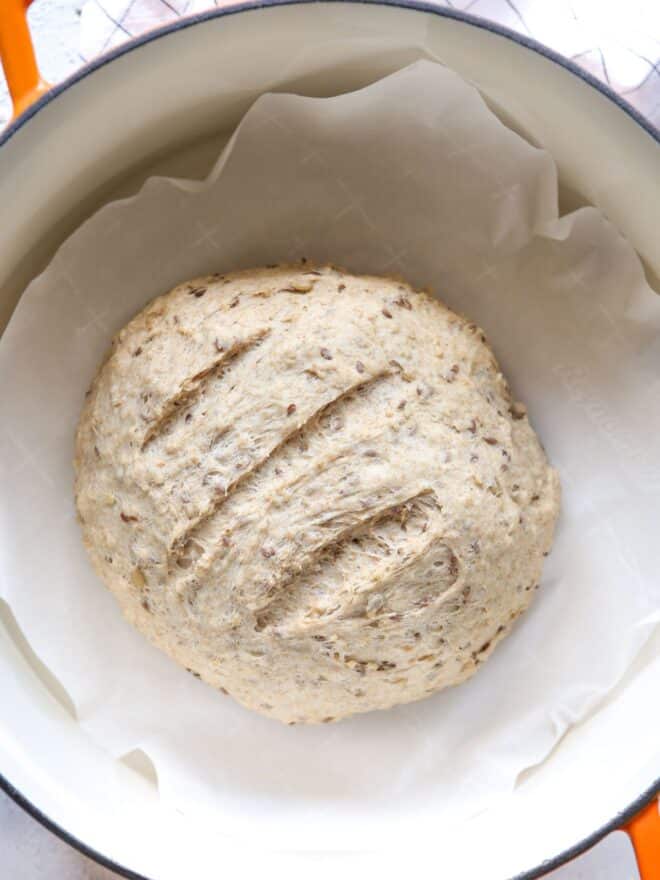
How to make this rustic multigrain bread
Like most yeast bread recipes, this rustic multigrain bread takes some time to make. But it’s not difficult! And it’s definitely a recipe anyone can make. Here’s a quick overview:
- Soak the wheat. Soak the bulgur wheat with warm water for 30 minutes to soften it.
- Warm wet ingredients to active yeast. Heat water, honey, and butter until warm and butter is melted.
- Mix dough. Combine yeast, whole wheat, rye flour, salt, soaked bulgur, oats, flax, sunflower seeds, and warm liquids to make a very wet dough.
- Add flour and knead. Gradually add all-purpose flour while kneading until dough is smooth, elastic, and only slightly tacky to touch.
- Let dough rise. Place dough in a large bowl, cover, and let rise 1 hour until doubled.
- Shape loaf. Punch down, knead briefly, form a ball, and place in a dutch oven lined with parchment.
- Rise again. Brush with egg wash, sprinkle oats, score top with 3 cuts, and let rise 30–45 minutes.
- Bake. Preheat oven to 425°F, but reduce it to 400°F when you put the bread in. Cover pot with the lid and bake for about 45 minutes until golden brown.
- Let cool. Remove bread from the pot and try to resist cutting into it until it has cooled completely. Then, enjoy!
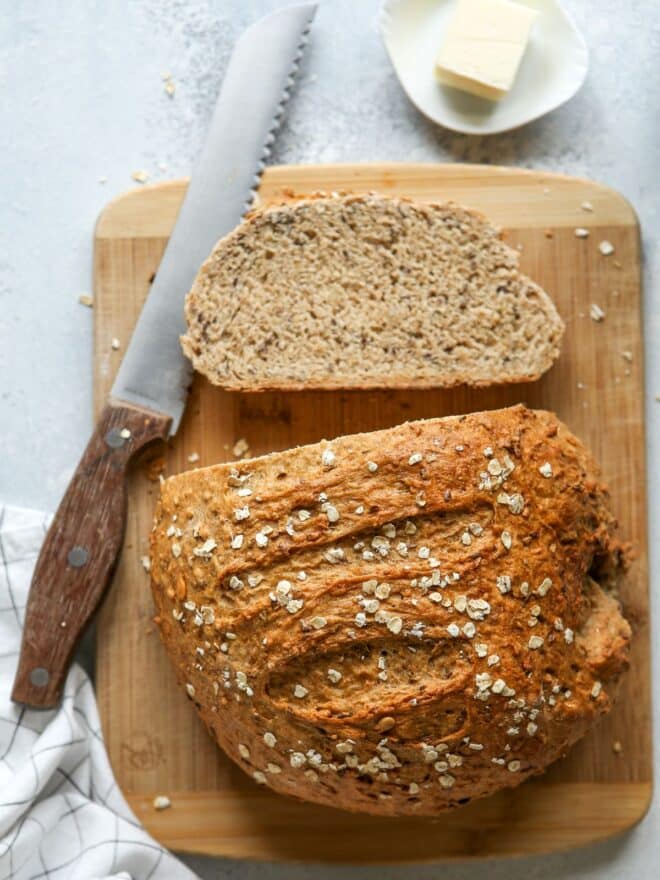
Why does this bread bake in a Dutch oven?
Baking in a covered Dutch oven traps steam released by the dough, creating a humid environment that helps the bread rise fully and makes a nice crisp, shiny crust. Without this steam, moisture escapes, causing the crust to harden too quickly and the bread to become dense and squat.
This is the dutch oven I use, but here is another great affordable option. Want more info on this method? This thorough post from The Perfect Loaf is very helpful, as is this one from King Arthur Flour.
Recipe FAQs
The multigrain texture and soaked bulgur make it tricky, but if your machine has a whole wheat or multigrain setting, you can experiment!
You really should use a Dutch oven! You’ll end up with a better loaf of bread. It conducts heat very well, making it ideal for this recipe, but if you don’t have a cast iron Dutch oven any heavy, oven-safe pot with a lid will work. Even covering a regular pot with foil can help mimic these ideal baking conditions and elevate your loaf.
It should be deep golden brown with a hollow sound when tapped on the bottom. You can also use a thermometer and bake to 195–205°F internal temp.
This hearty multigrain bread will keep at room temperature for several days, though I recommend enjoying it within 48 hours for the most freshness. It also freezes really well. Wrap it in 2 layers of plastic wrap and freeze for up to 1-2 months. Thaw at room temperature, then warm uncovered in a 350°F for
More bread recipes
Get the recipe
Multigrain Bread
Ingredients
- 3 tablespoons (30 grams) bulgur wheat
- 1 ¼ cup (283 grams) water , divided
- 2 tablespoons (43 grams) honey
- 2 tablespoons (28 grams) unsalted butter
- 2 ¼ teaspoons (7 grams) active-dry yeast
- 1 ½ cup (170 grams) whole wheat flour
- ½ cup (50 grams) rye flour
- 2 teaspoons coarse salt
- ¼ cup (25 grams) old-fashioned rolled oats
- ¼ cup (35 grams) flaxseed
- 2 tablespoon (20 grams) raw sunflower seeds
- 1 – 1 ½ cups (120-170 grams) all-purpose flour
- 1 large egg + 1 tablespoon water , beaten for egg wash (optional)
- Additional rolled oats , for sprinkling (optional)
Equipment


Instructions
- Soak the bulgur wheat in ¼ cup warm water for 30 minutes, or until all water is absorbed.3 tablespoons (30 grams) bulgur wheat, 0.25 cup (56.6 grams) water
- In a small saucepan, combine the remaining 1 cup water, honey, and butter. Place over medium heat until butter is melted. Remove from heat and let cool for about 5 minutes (to about 120-130°F).1 ¼ cup (283 grams) water, 2 tablespoons (43 grams) honey, 2 tablespoons (28 grams) unsalted butter
- Meanwhile, in the bowl of a stand mixer fitted with a dough hook, combine the yeast, whole wheat flour, rye flour, and salt. Pour in the warm water mixture and mix until combined. Add the rolled oats, flaxseed, sunflower seeds and soaked bulgur wheat and mix until combined.2 ¼ teaspoons (7 grams) active-dry yeast, 1 ½ cup (170 grams) whole wheat flour, ½ cup (50 grams) rye flour, 2 teaspoons coarse salt, ¼ cup (25 grams) old-fashioned rolled oats, ¼ cup (35 grams) flaxseed, 2 tablespoon (20 grams) raw sunflower seeds
- Add the all-purpose flour a few tablespoons at a time until the dough clears the bowl (you may not use all 1 ½ cups of the flour). Continue kneading in the mixer until the dough is smooth and elastic, about 3-4 minutes. This dough is heavier than many bread dough, but you should be able to pull it a bit without it immediately breaking.1 – 1 ½ cups (120-170 grams) all-purpose flour
- Gather dough into a ball and place in a greased bowl. Cover with plastic wrap and place in a warm place. Let rise until doubled and it doesn’t bounce back when pressed, about 1 hour. Punch down dough and knead a few times until smooth. Let rest for about 5 minutes.
- Place dough in a dutch oven or large heavy pot lined with parchment paper. Brush with egg wash and sprinkle with rolled oats, if desired. Use a sharp knife to slice 3 cuts into the top of the bread. Cover with plastic wrap and let rise for an additional 30-45 minutes.1 large egg + 1 tablespoon water, Additional rolled oats
- Meanwhile, preheat oven to 425°F and place oven rack in the center of the oven (or lower if necessary to fit the pot). When ready to bake, cover the dutch oven with a lid and place in the oven. Turn the oven temp down to 400°F and bake for about 45 minutes, until the top of the bread is golden brown.
- Let bread cool before slicing. It is best enjoyed the day it is baked, but will keep in an airtight container at room temperature for several days.
Notes


This looked beautiful and round going into the oven and smelled amazing while baking but turned out flat! :/ don’t know what went wrong. First time with seeded bread.
I’ve just learned about this Andrea. It is likely that your yeast was dead, either from age or from the water being too hot. If you had good luck with the rising process, it may be that you used too much yeast.
This is the perfect grainy bread to satisfy the craving for a dense bread.
I am gonna try it! Yemmyyyyyyy
Thanks for sharing this lovely recipe
Multigrain bread is healthy and tasty. Better than other bread.
Delicious and yum-yum multigrain bread.
I wanted to let you know that I made this bread today. It is absolutely delicious! It’s not crumbly or anything when I cut it like some of the people commented on. Great recipe… Delicious flavor… Super easy to make! I baked mine in an Emile Henry Artisan Baker! Perfect. Thanks for sharing.
This bread is extremely satisfying to make and the results have been picture perfect every time. I have made this bread almost every weekend for the past month now (as global pandemics tend to make people into bread bakers) and I’ve added or substituted a couple of things with the following results:
Substituted: Buckwheat flour for Rye Flour = Bread that is as dense as a piece of cardboard. Didn’t have rye flour on hand at the time so figured buckwheat would be somewhat similar. Came out like thick multigrain scandanavian bread. Rye flour definitely makes it fluffier.
Substituted: 7 Grain Hot Cereal for Bulgur Wheat = Similar texture; I just didn’t have bulgur wheat on hand but it works just the same it seems.
Added: I make a seed topping of rolled oats, sunflower seeds, flax seeds, black & white sesame seeds, and pepitas. Adds a great texture on top but tends to get a little messy. It’s like a birdfeeder exploded every time I cut the loaf but I personally think it’s worth it.
Added: I used gluten free flour (rice and potato flour) to dust my countertop when kneading/folding the dough before placing in the dutch oven and letting it rest for another 45 mins. Bread noticeably rose higher than before when I didn’t do this. I think it has something to do with the added gluten for the yeast to eat?
All in all, thank you for providing a beautiful foundational recipe for multi-grain bread!
This was wonderful. I followed the recipe exactly (with one tiny adjustment because I didn’t have Rye flour so I used whole wheat for that small amount). It was fabulous!
Thank you for posting this. My only issue is trying to have the willpower to not eat too much of it right now!
Annalise,
Thank you so much for this recipe! I was looking for a multi-grain dinner roll recipe and came across this. I hope you don’t mind that I made it into rolls. I always make 100% whole wheat bread for my family and wanted to try these with all whole wheat and rye flour. I increased the rye as well. I know I’m supposed to try a recipe first just like it is written, and I do hope you don’t mind me making changes. I used my 15 inch cast iron skillet with a lid to bake the rolls. They were delicious! My family loved them!
I got into baking when my kids were little and primarily stuck with cakes and cupcakes but lately had the desire to try my hand at bread making (without a machine). My first go was sourdough bread and I crashed and burned but then I stumbled upon your site and your multigrain bread was a huge success. Followed your directions to the letter and turned out great. The family asked me to make it again this weekend. Thank you for sharing and restoring my confidence to keep making bread. I will need to try some of your other recipes and compare.
Great flavor. Great texture. My wife is going to love this bread. One question and I’m new to the baking world, What is the purpose Punching down the dough?
Thanks for your help.
Patrick
That’s a great question! I’ve learned a lot about bread baking through one of my clients, Red Star Yeast. Here’s what their website says (they explain it better than I could!): “After the dough has risen in the mixing bowl, it has to be punched down. Despite the harsh sounding name of this step, you must be gentle to your dough. Punching down removes some of the gas bubbles formed by the yeast during rising and produces a finer grain. It also redistributes the yeast cells, sugar and moisture so they can ferment and rise the dough during the proofing stage.” I hope this helps!
Hello, can you tell me what “coast salt” is? Do you mean coarse salt? Or is this a kind of salt I’ve not heard of? If you do mean coarse, do you use kosher coarse? Thank you! The bread looks delicious!
Lol, definitely supposed to say “coarse salt”. I’ve fixed it, thanks!
I made this today and loved it. Very easy to make and delicious. I used a cast iron deep skillet and aluminum foil on top since I did not have a lid. Baked it for the time indicated in recipe and was perfectly brown. I doubled the recipe and made 2 loaves. I only had to add about 1/2 cup of the white flour to have it hold together. I will be making it again!! I was surprised to find rye flour is difficult to locate is small town groceries. I did find it though!
Does anyone have experience making dinner rolls from this recipe? Loved the loaf. Looking to take to my next book club …
I should try making these into individual rolls – love that idea! Will report back when I do. 🙂
Hello! This recipe was my first attempt at baking bread and I pretty much followed it exactly as indicated, aside from adding all of the white flour at the end … I felt that it didn’t really need it and that I would have lost some of the elasticity of the dough. That being said, it came out perfectly (my Wife’s comment, not mine)! Now that I know it works, and that it’s delicious … I wanted to play with the recipe a bit. I’m thinking of adding a couple of tablespoons of unsulphered molasses to the recipe (which might have me also use more of the white flour than I previously did … any reason why not to do this?